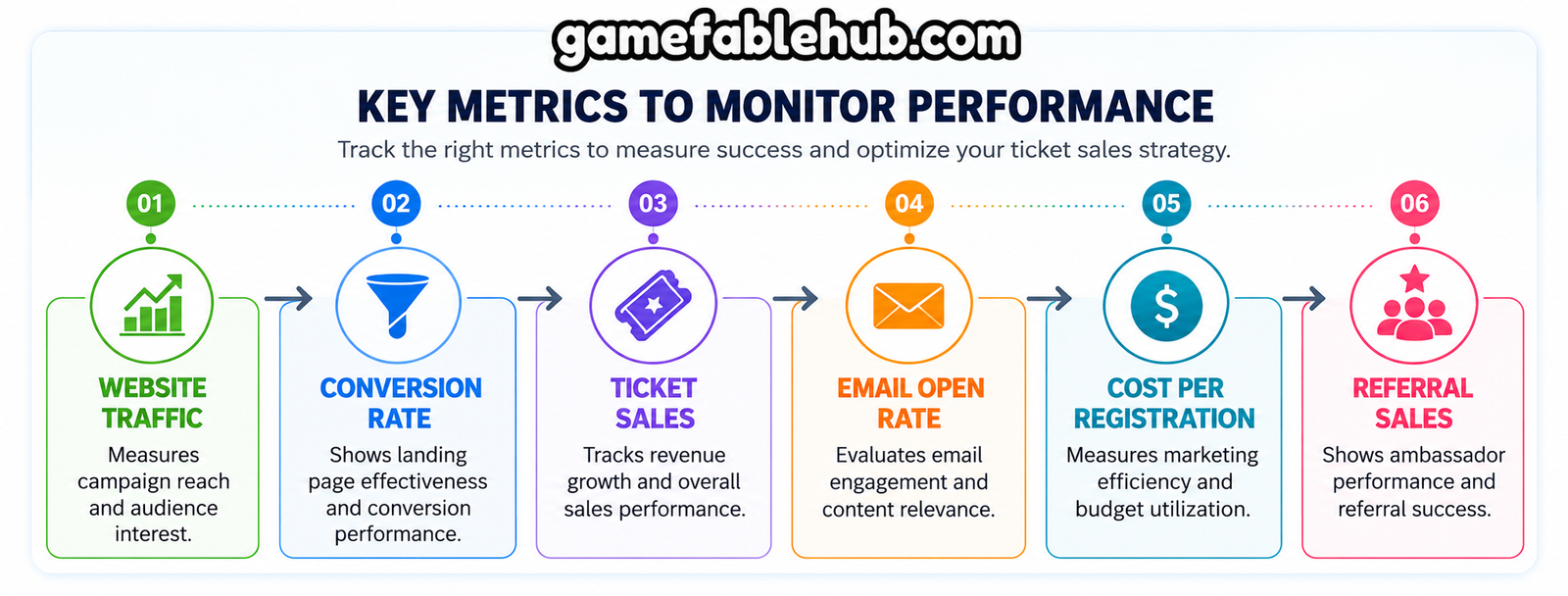
GamificationSummit ticket sales effectiveness concerns how successfully an event turns audience interest into paid registrations while managing marketing costs, discounts, refunds, and attendance. GamificationSummit ticket sales effectiveness it requires more than counting tickets: organizers need to understand which activities attract suitable buyers and what remains after the associated costs.
Table of Contents
GamificationSummit publishes content discussing ticket-sales performance and optimization. However, the reviewed article does not establish an independently audited performance report for a specific event edition. Its recommendations should therefore be distinguished from verified results.
This guide provides an independent measurement framework. All numerical examples are hypothetical, and none should be interpreted as actual GamificationSummit sales data.
The aim is to help event teams ask better questions before changing prices, increasing advertising, or redesigning checkout.
What Does Ticket Sales Effectiveness Actually Measure?
Ticket volume answers one question: how many tickets were sold?
Effectiveness asks several more.
How many prospective buyers visited the sales page? What did acquiring those buyers cost? Which ticket categories generated revenue? How many purchases were refunded? Did buyers attend?
Consider two hypothetical campaigns.
One sells 300 tickets after substantial advertising and heavy discounts. Another sells 250 tickets with lower acquisition spending and a higher average selling price.
The first campaign leads on volume. The second might produce a better financial outcome.
Neither can be judged properly without examining costs, ticket inclusions, and the event’s objectives.
A useful assessment of gamificationsummit ticket sales effectiveness begins by defining the outcome the organizer actually wants.
Set the Objective Before Choosing the Metrics
Different events can have different priorities.
An established conference may prioritize sustainable revenue. A first edition may emphasize attracting a relevant audience. A specialist workshop may need a small number of appropriately qualified participants.
Write down the primary objective and its constraints.
For example:
“Sell 400 paid admissions within the venue’s approved capacity while keeping acquisition spending within the agreed budget.”
Then define what counts as a sale.
Does the report include complimentary passes, unpaid reservations, canceled orders, or refunded tickets?
Keep these categories separate.
Otherwise, the headline total may combine people with very different relationships to the event.
Clear definitions make later comparisons more meaningful.
1. Check Ticket-Page Conversion Rate
Ticket-page conversion measures the proportion of a defined audience that completes a purchase.
A simple version is:
Purchase conversion rate = completed purchase orders ÷ ticket-page sessions × 100
Suppose a page receives 5,000 sessions and generates 200 completed orders.
The conversion rate is:
200 ÷ 5,000 × 100 = 4%
That figure needs context.
An order may contain several tickets, and one person may visit more than once. Sessions, unique visitors, orders, and tickets are different units.
Choose a definition and apply it consistently.
For gamificationsummit ticket sales effectiveness, compare equivalent periods and audiences. Traffic from previous attendees may behave differently from visitors encountering the event for the first time.
2. Check Where Buyers Leave the Purchase Process
A final conversion rate cannot explain every obstacle.
Map the main stages:
- Ticket-page visit.
- Ticket selection.
- Checkout start.
- Payment attempt.
- Completed order.
Then examine the movement between stages.
If visitors rarely select a ticket, investigate the offer, eligibility, schedule, or price presentation.
If buyers begin checkout but payment attempts fail, investigate the relevant technical or payment issue.
Do not assume every incomplete purchase represents a defective form. Some visitors are comparing options, seeking employer approval, or checking availability.
Combine the numbers with support questions and careful testing.
The purpose is to identify a plausible cause before selecting a remedy.
3. Check Actual Revenue per Paid Ticket
Published ticket prices do not necessarily describe what the organizer receives.
Discounts, bundles, fees, and refunds can change the picture.
Define a consistent measure such as:
Average ticket revenue = recognized ticket revenue ÷ relevant paid tickets
Specify how taxes, platform fees, refunds, and other adjustments are treated.
For example, if a hypothetical reporting period records $18,000 in ticket revenue across 150 paid tickets, the average is $120.
That does not automatically represent profit.
Event delivery costs and other expenses still matter.
When reviewing gamificationsummit ticket sales effectiveness, examine whether changes in average revenue reflect ticket mix, discounts, upgrades, or accounting adjustments rather than assuming one explanation.
4. Check Acquisition Cost by Channel
A channel that generates many sales may also require substantial spending.
Start with a clearly defined cost calculation.
Cost per acquired order = attributable acquisition spending ÷ attributable completed orders
Suppose a campaign costs $1,200 and produces 30 attributable orders.
The cost is $40 per order.
If some orders contain multiple tickets, cost per ticket will differ.
Specify which costs are included. Advertising spend alone is different from a fully loaded figure that includes creative production, agency work, and other resources.
Attribution also has limits. A buyer may encounter several channels before purchasing.
Use consistent reporting rules and avoid presenting a platform’s attributed sales as a complete explanation of the customer journey.
5. Check Sales Pace Against the Event Calendar
Sales pace describes how purchases develop over time.
Track tickets sold during a defined period, alongside cumulative sales.
A weekly report can show whether activity changed after an announcement, pricing deadline, or campaign.
However, there is no universal sales curve that every event must follow.
Compare against your event’s history where relevant, while accounting for changes in capacity, audience, price, and promotional timing.
A first edition may need scenario-based planning instead.
For gamificationsummit ticket sales effectiveness, the useful question is whether current sales support the organizer’s plan and what evidence explains any gap.
Avoid inventing a last-minute surge simply because the forecast requires one.
6. Check Discounts Against the Resulting Revenue
A discount may increase purchases while reducing average revenue.
Both effects need to be measured.
Consider an illustrative ticket priced at $150, discounted to $120.
Selling 100 tickets at the full price produces $15,000. Selling 120 at the discounted price produces $14,400.
The discounted offer sells more tickets but produces less gross ticket revenue in this simplified example.
That does not establish that the promotion was a mistake. Attendance, sponsorship commitments, delivery costs, and other objectives may matter.
It does show why ticket volume alone is insufficient.
Evaluate a discount according to its purpose, eligibility, costs, and observed results.
7. Check Refunds, Cancellations, and Disputes
Gross sales can overstate the final outcome.
Separate completed purchases from subsequent refunds, cancellations, and payment disputes.
Choose a consistent reporting period and denominator.
For example:
Refunded-ticket rate = refunded tickets ÷ tickets sold in the defined group × 100
Be careful when comparing recent and older purchases. Recent buyers may not yet have had the same opportunity to request a refund.
Record the reasons where available.
A schedule change, unclear ticket description, duplicate order, and payment problem call for different responses.
A credible gamificationsummit ticket sales effectiveness report should explain these adjustments rather than allowing the initial sales total to represent the entire result.
8. Check Whether Ticket Categories Match Buyer Needs
Several ticket tiers can serve different requirements, but unclear distinctions may make comparison difficult.
Explain what each category includes.
Relevant differences might involve workshop access, recordings, meals, or additional sessions—only where those benefits actually exist.
State exclusions and conditions clearly.
Then examine purchases, support questions, and checkout behavior by ticket category.
A rarely selected premium tier may be poorly explained, unsuitable for the audience, or priced beyond demand. The data alone may not identify which.
Avoid adding benefits that the event cannot reliably deliver.
Ticket design should make the offer understandable, not merely create a more expensive option.
9. Check Attendance Alongside Sales
A paid registration and an attended event are different outcomes.
Where attendance tracking is available, define what counts as attendance.
An in-person event may use check-in records. An online event may require a meaningful participation definition rather than simply counting account creation.
Calculate attendance using the appropriate eligible population.
Keep complimentary and paid categories separate where that distinction matters.
Attendance information can help evaluate access instructions, reminders, scheduling, and the fit between promotion and the actual experience.
It also adds context to gamificationsummit ticket sales effectiveness: selling admission is one stage of delivering an event, not the complete attendee journey.
Build a Dashboard That Supports Decisions
A concise dashboard is easier to use when every measure answers a question.
| Measure | Question it helps answer |
|---|---|
| Paid tickets sold | How much confirmed demand exists? |
| Purchase conversion | What proportion of measured visits produces orders? |
| Checkout completion | Where might purchase friction occur? |
| Average ticket revenue | What revenue does the ticket mix produce? |
| Acquisition cost | What spending is associated with purchases? |
| Weekly sales pace | How does demand develop over time? |
| Refund adjustments | How much initial revenue remains? |
| Attendance | How many eligible registrants participate? |
Add definitions beside the figures.
Record the reporting period, source, treatment of adjustments, and person responsible for checking the data.
A smaller set of reliable measures is preferable to a large dashboard containing inconsistent totals.
Improve the Sales Page Before Adding Complexity
Review whether a prospective attendee can answer basic questions.
What is the event? Who is it intended for? When does it happen? What does the ticket include? Where does participation take place?
Identify confirmed speakers and sessions accurately.
Make total pricing, important conditions, and support access easy to find.
Check the experience on relevant devices and with common accessibility needs in mind.
These are practical review steps, not guaranteed conversion improvements.
For gamificationsummit ticket sales effectiveness, page changes should address observed confusion or a clear usability issue.
Adding badges, animation, or more persuasive language without understanding the problem may create unnecessary complexity.
Test Changes Without Overstating the Evidence
A test needs a defined question.
For example:
“Does explaining workshop eligibility beside the ticket selection reduce related questions and improve completed purchases?”
Identify the primary measure before starting.
Keep the comparison as fair as practical. Changing the ticket price, advertising audience, and checkout design together makes interpretation difficult.
Small samples and changing traffic can produce misleading differences.
A higher conversion rate after a redesign does not automatically prove the redesign caused it.
Where controlled testing is impractical, document the timing and competing explanations.
Treat the result as evidence to interpret rather than a reason to declare every change a proven success.
Use Gamification Only When It Serves the Event
The event name does not establish that game mechanics are necessary in its purchase process.
If organizers consider challenges, referral rewards, points, or badges, they should define the purpose first.
Does the activity help suitable attendees discover relevant content? Are the rules understandable? Can rewards be delivered fairly?
Avoid making essential ticket information dependent on completing a game.
Use genuine deadlines and availability information. Do not manufacture countdowns or false scarcity.
Referral activity should also be measured carefully. A shared link is not the same as a completed purchase, and an attributed purchase is not automatically an additional sale that would otherwise never have happened.
A Hypothetical Campaign Review
Imagine an event sells 240 tickets after receiving 8,000 ticket-page sessions.
The team notices that mobile checkout completion is lower than desktop completion.
Rather than immediately increasing advertising, it tests the mobile process.
The review discovers that a required field behaves incorrectly on some devices. The team resolves the issue and checks subsequent purchases.
Meanwhile, it reviews average ticket revenue because a recent discount increased volume.
This example illustrates a process, not actual GamificationSummit results.
It shows how gamificationsummit ticket sales effectiveness can be examined through connected questions: demand, usability, pricing, and costs.
Common Reporting Mistakes
Mixing Tickets and Orders
One order can contain several admissions. Label both measures clearly.
Counting Reservations as Paid Sales
Separate unpaid holds from completed payments.
Ignoring Refund Timing
Initial revenue and final retained revenue may differ.
Using Unrelated Benchmarks
An expensive specialist conference and a free community event do not necessarily provide useful conversion comparisons.
Treating Attribution as Certainty
Marketing systems assign credit according to reporting rules, not perfect knowledge of buyer motivation.
Reporting Only Successful Campaigns
A complete review includes spending and results from activities that did not meet expectations.
Confusing Revenue with Profit
Ticket revenue does not account for every cost of acquiring buyers and delivering the event.
Frequently Asked Questions
What is gamificationsummit ticket sales effectiveness?
It describes how efficiently an event converts interest into paid registrations while considering revenue, acquisition costs, refunds, and related outcomes.
Are actual GamificationSummit sales figures available here?
No. This article does not present independently audited event results. Its calculations use hypothetical examples.
What is the most important metric?
That depends on the objective. Paid volume, net revenue, acquisition cost, and attendance answer different questions.
Do discounts always improve effectiveness?
No. A discount can increase purchases while reducing revenue per ticket. Evaluate the complete result.
Can better checkout design guarantee more sales?
No. Checkout is one part of the process. Demand, timing, pricing, technical conditions, and audience fit also matter.
Does gamification need to be part of ticket sales?
No. Introduce it only where it provides a clear benefit without obstructing access or misleading prospective buyers.
Conclusion
GamificationSummit ticket sales effectiveness is best assessed through clearly defined outcomes and reliable records.
Track the path from interest to purchase, account for costs and adjustments, and connect changes to specific questions. That gives organizers a useful basis for decisions without relying on unsupported benchmarks or promised sales increases.
About the Author