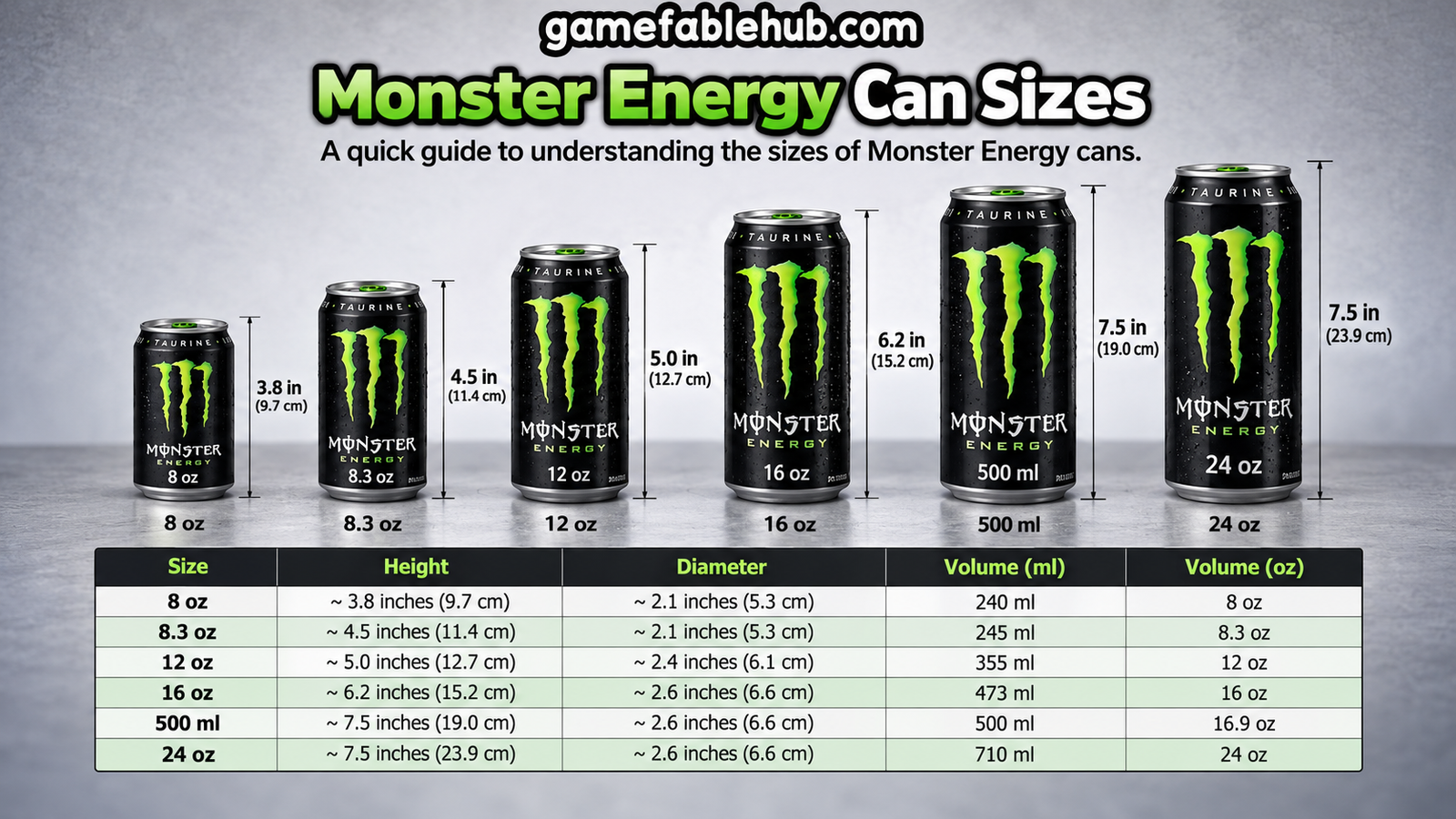
How tall is a Monster can? A typical 16 US fl oz Monster can is approximately 6.2 inches tall, or 15.7 centimeters. A standard 500 ml version is approximately 6.6 inches tall, or 16.8 centimeters.
The correct answer depends on the can’s capacity and packaging format. A 16 fl oz can and a 500 ml can may look similar, but they do not contain exactly the same amount of liquid.
These measurements are useful planning estimates based on standard beverage-can formats. For a tight shelf, fitted holder, or packaging project, measure your actual Monster can because a general specification is not a guaranteed finished dimension for every product.
Here are seven facts that explain the differences and help you choose the right measurement.
1. The Can’s Capacity Determines Which Height to Check
Before measuring anything, read the volume printed on the label.
Monster’s U.S. Original Green product page lists a 16 oz option, while its UK product page identifies a 500 ml can. These are different capacities.
A U.S. fluid ounce measures volume. Inches and centimeters measure length. The two types of measurement answer different questions.
| Label information | What it tells you |
|---|---|
| 16 fl oz | How much liquid the can contains |
| 473 ml | Approximately the same volume as 16 US fl oz |
| 500 ml | A slightly larger liquid capacity |
| Height | The vertical distance from bottom to top |
| Diameter | The distance across the circular body |
When someone asks how tall is a Monster can, checking the label first prevents the most common mistake: applying a measurement from one format to another.
Why Appearance Can Be Misleading
Two cans may share a similar logo, color scheme, and width while having different heights.
A photograph also makes comparison difficult. Camera angle, distance, and cropping can change how tall an object appears.
The printed capacity is a better starting point than the artwork.
2. A Typical 16 Fl Oz Can Is About 6.2 Inches Tall
For the familiar 16 US fl oz format, about 6.2 inches is a practical height estimate.
That is roughly 15.7 centimeters.
As a packaging reference, Crown lists its standard 473 ml beverage can at 157.23 mm high. This supports the approximate size, but it should not be described as a Monster-issued specification for every finished retail can.
When This Estimate Is Useful
An approximate height can help with:
- Planning a display shelf.
- Comparing containers.
- Sketching a storage layout.
- Estimating space inside a bag.
- Creating a rough product illustration.
For a close-fitting compartment, a physical measurement is more useful than a rounded online figure.
If your reason for asking how tall is a Monster can involves a holder or cabinet, also consider how you will put the can in and take it out.
An opening that barely matches the can’s height may be awkward to use.
3. A Standard 500 Ml Can Is Taller
For a standard 500 ml format, a useful estimate is about 6.6 inches, or 16.8 centimeters.
Crown’s standard 500 ml beverage-can reference lists a height of 168 mm. Again, that is a standard packaging reference rather than confirmation of the exact finished dimensions of every Monster product.
The difference between the two reference heights is approximately 11 mm, or a little over one centimeter.
That may not look dramatic, but it can matter inside a shallow drawer or beneath a fixed shelf.
Quick Height Comparison
| Common format | Approximate height | Approximate height in centimeters |
|---|---|---|
| 16 US fl oz / 473 ml | 6.2 inches | 15.7 cm |
| 500 ml | 6.6 inches | 16.8 cm |
Use this table for general comparison. Measure the actual container before designing something around it.
The answer to how tall is a Monster can should therefore identify the format rather than present one number as universal.
4. A 500 Ml Can Is Not Exactly 16 US Fluid Ounces
Product descriptions sometimes treat 16 fl oz and 500 ml as interchangeable. They are close, but they are not equal.
Using U.S. fluid ounces:
- 16 fl oz is approximately 473 ml.
- 500 ml is approximately 16.9 fl oz.
The difference is approximately 27 ml.
That explains why a 500 ml container can require more space even when its general shape resembles a 16 fl oz can.
Capacity Does Not Fix Every Dimension
Volume alone does not determine height.
A container can hold additional liquid by becoming taller, wider, or both. Different shapes can also hold the same volume.
For example, a short, wide cylinder and a tall, narrow cylinder can have equal internal capacities.
This is why you should not calculate the height of an unfamiliar Monster package by scaling another can’s height according to its volume.
For how tall is a Monster can, the exact packaging format matters alongside the number printed on the label.
5. Height and Diameter Matter for Different Reasons
Height tells you whether a can fits under a shelf. Diameter helps determine whether it fits through an opening or inside a holder.
The standard 473 ml and 500 ml packaging references discussed here both list a body diameter of approximately 66 mm, or 2.6 inches.
However, the body, top rim, and base are not necessarily identical in width.
Measure the Widest Point for a Holder
If you are checking a cup holder or circular compartment, measure the can where it is widest.
Do not assume that the diameter of the top opening represents the whole container.
Also account for anything added around the can, such as:
- An insulating sleeve.
- A protective cover.
- A display holder.
- Packing material.
- A reusable outer container.
Measure the Space as Well
A holder may narrow toward the bottom. A compartment may have a smaller entrance than its interior.
Check both the can and the opening it needs to pass through.
Knowing how tall is a Monster can answers only part of a fit question. The usable space around it matters too.
6. Different Products Need Separate Measurements
A brand name is not a dimensional standard.
Do not assume that every Monster-branded drink uses the same container simply because the design looks familiar.
Check the capacity, shape, and closure of the product in front of you.
Does Flavor Change the Height?
Flavor does not provide enough information to determine height.
Two flavors sold in the same packaging format may have similar dimensions. But a shared brand or flavor family does not prove that their containers match.
A useful comparison identifies the volume and container type first.
What About Larger or Specialty Cans?
Measure them separately.
Avoid taking a standard-can estimate and applying it automatically to a larger container, resealable package, or another format.
If you are comparing several products, create a simple record:
| Product | Printed capacity | Measured height | Measured maximum width |
|---|---|---|---|
| Can A | Record label | Measure directly | Measure directly |
| Can B | Record label | Measure directly | Measure directly |
This gives you a reliable answer to how tall is a Monster can for the specific products you actually use.
7. Measuring Your Own Can Gives the Best Fit Information
A ruler is enough for most household measurements.
You do not need specialized equipment to get a useful result, although calipers can help when measuring diameter precisely.
Step 1: Use a Flat Surface
Stand an undamaged can upright on a level table.
A soft surface can let the can tilt, making the reading less reliable.
Step 2: Place the Ruler Beside It
Keep the ruler vertical and make sure its zero mark lines up with the surface supporting the can.
Some rulers have a small gap between their physical edge and the zero mark. Account for that gap.
Step 3: Read at Eye Level
Look straight across at the highest part of the can.
Viewing from above or below can make the measurement appear different.
Step 4: Include the Whole Container
For storage purposes, measure from the supporting surface to the highest point.
If a tab has been lifted or a closure changes the overall height, measure the can in the condition in which you intend to store it.
Step 5: Repeat the Reading
Measure again after rotating the can or repositioning the ruler.
If the readings differ noticeably, check that the can is upright and the ruler starts at the correct point.
For a project requiring close tolerances, this process is more useful than relying only on a search result for how tall is a Monster can.
How to Convert the Measurement
If your ruler uses a different unit from your project, convert the result.
The basic relationships are:
- 1 inch = 2.54 centimeters
- 1 centimeter = 10 millimeters
To convert centimeters to inches, divide by 2.54.
For example:
16.8 ÷ 2.54 ≈ 6.61 inchesTo convert inches to centimeters, multiply by 2.54.
6.2 × 2.54 = 15.748 centimetersThe small difference between rounded figures is normal. “About 6.2 inches” is not intended to describe a measurement precise to a fraction of a millimeter.
Keep the original measurement if accuracy matters, and round only when presenting the final result.
Planning Shelf, Drawer, and Cooler Space
If you are researching how tall is a Monster can for storage, leave usable clearance rather than designing around a single exact number.
A can needs room to enter the space, remain upright, and come out again.
For a Shelf
Measure from the shelf surface to the lowest obstruction above it.
That obstruction could be a bracket, trim piece, or the underside of another shelf.
For a Drawer
Check the clearance when the drawer closes, not just the visible height while it is open.
Internal rails or supports may reduce the available space.
For a Cooler
Consider the internal dimensions, lid shape, and any space occupied by ice or dividers.
The exterior dimensions of a cooler do not tell you its usable internal capacity.
For a Display or Model
Use approximate dimensions for an early sketch, then replace them with measurements from the actual product before making a fitted component.
This avoids rebuilding a project because a rounded estimate was treated as exact.
Common Measurement Mistakes
Several small mistakes can produce confusing answers.
Confusing a Multipack With a Single Can
Retail listings may show dimensions for a case, tray, or shipping package.
Confirm that the measurements refer to one can before using them.
Treating Milliliters as a Height Measurement
A 500 ml label describes liquid capacity. It does not directly state the can’s height.
Using a Photograph as a Ruler
Without a reliable scale and a straight viewing angle, photographs provide only rough comparisons.
Mixing U.S. and Other Fluid-Ounce Units
When converting a label, identify the unit system. The 473 ml comparison in this article refers to U.S. fluid ounces.
Ignoring Damage
A crushed base, dented side, or distorted rim can affect how a can stands and measures.
Use an undamaged container when checking the intended dimensions.
Frequently Asked Questions
How tall is a Monster can in inches?
A typical 16 US fl oz can is approximately 6.2 inches tall. A standard 500 ml version is approximately 6.6 inches tall. Check the actual container for a precise fit.
How tall is a Monster can in centimeters?
The common planning estimates are about 15.7 cm for the 16 fl oz format and 16.8 cm for the standard 500 ml format.
Are all Monster cans the same height?
No. Capacity and packaging format can differ. Read the label and measure the particular container.
Is a 500 ml can the same as a 16 oz can?
Not exactly. Sixteen U.S. fluid ounces is approximately 473 ml, while 500 ml is approximately 16.9 U.S. fluid ounces.
How wide is a standard Monster can?
A useful standard-format reference is around 6.6 cm, or 2.6 inches, across the body. For a fitted holder, measure the widest part of your actual can.
Does an empty can have a different height?
An undamaged empty can should retain essentially the same external dimensions. Crushing or bending it changes the measurement.
Can I use these dimensions for a custom holder?
Use them for initial planning. Measure your actual can and allow suitable clearance before producing the finished holder.
Choose the Measurement That Matches Your Can
The practical answer to how tall is a Monster can is about 6.2 inches for a typical 16 US fl oz format and 6.6 inches for a standard 500 ml format.
Check the printed capacity first. If your project depends on a close fit, measure the finished container’s height and maximum width directly.
About the Author