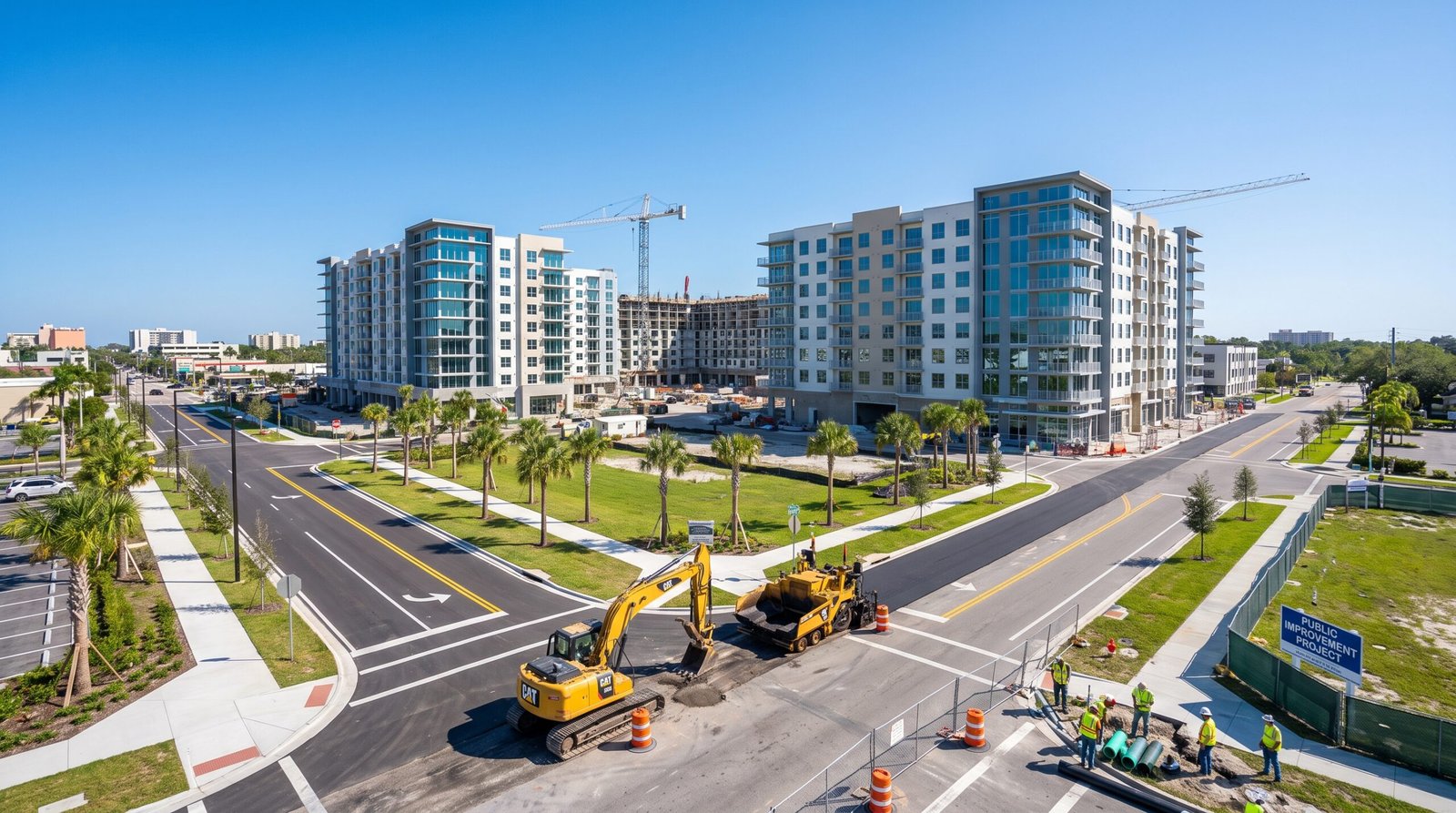
The city of largo fl megaprojects since 2024-08-27 include downtown redevelopment, road construction, stormwater improvements, wastewater infrastructure, and upgrades to public facilities. Among the most notable developments are Horizon West Bay, the Rosery Road improvement program, and broader investments in transportation and essential city infrastructure. These projects are important because they influence how residents travel, access public services, and experience Largo’s changing neighborhoods.
Largo, located in Pinellas County on Florida’s Gulf Coast, is an established city with residential communities, commercial areas, parks, and public facilities. Its development is not limited to constructing new buildings. Maintaining roads, improving drainage, modernizing utilities, and investing in recreation facilities are also essential parts of long-term urban planning.
Table of Contents
Since August 27, 2024, ongoing construction and infrastructure planning have remained important subjects for residents and businesses. Some projects discussed in this article began before that date but continued to be relevant during the reporting period. Their original announcement dates, planned completion dates, and current statuses must be distinguished carefully.
A capital improvement program does not automatically mean that every listed project has entered construction. Some projects may be in design, procurement, or budgeting, while others may already be underway. Understanding these differences helps provide a more accurate picture of Largo’s development.
Overview of City of Largo FL Megaprojects Since 2024
Largo’s development program combines visible downtown construction with improvements to the infrastructure that keeps the city operating. A new municipal complex can change the appearance of a commercial district, while drainage improvements and wastewater upgrades can provide important benefits without dramatically changing the streetscape.
The city’s FY2024–FY2028 Capital Improvements Program identified approximately $200.25 million in planned capital improvements across five fiscal years. The program covers facilities, mobility, recreation, stormwater, technology, vehicles, and wastewater. This figure represents a multiyear planning total rather than a single construction contract or confirmed expenditure.
These investments illustrate the range of priorities involved in managing an established Florida city. Downtown redevelopment can support commercial activity, transportation projects can improve street conditions, and utility improvements can help maintain reliable public services.
Three areas stand out when examining Largo Florida development projects: downtown redevelopment, transportation improvements, and essential public infrastructure. Each area has different objectives, funding requirements, and construction schedules.
Horizon West Bay: A Major Downtown Largo Redevelopment Project
Horizon West Bay is one of the most prominent developments associated with Largo’s recent construction activity. The mixed-use municipal complex includes the city’s new City Hall and a public parking garage. The city’s broader vision includes commercial space intended to attract restaurants, cafés, retailers, and other businesses to Downtown Largo.
Located along West Bay Drive, the project aims to support a more active downtown environment. By bringing municipal facilities and commercial opportunities together, the development is intended to encourage people to visit downtown for public services and other activities.
Construction Progress and Project Development
Official City of Largo updates documented continuing construction activity at Horizon West Bay during 2025. A city-manager update published on June 6, 2025, reported work involving electrical systems, mechanical installations, and exterior glass at the parking garage.
A later update dated October 31, 2025, described additional activities involving site lighting, interior painting, landscaping, geothermal wells, HVAC and fire-alarm testing, and reconstruction of 5th Street NW.
These updates show that construction involved several stages, including building systems, exterior work, and surrounding infrastructure. However, an update describing construction activity does not automatically establish that every part of the development has opened or become fully operational.
The project was already under construction before August 27, 2024. It is therefore more accurate to describe Horizon West Bay as a continuing redevelopment project during the reporting period rather than a development first announced after that date.
Why Horizon West Bay Matters
Horizon West Bay could influence Downtown Largo in several ways. A consolidated municipal facility can affect how residents access city services, where employees work, and how visitors use nearby parking.
The commercial component is also important. Restaurants, cafés, and retail businesses can help create activity beyond normal municipal office hours. Whether this goal is achieved will depend on business occupancy, pedestrian access, and the relationship between the development and existing downtown businesses.
Construction has also affected nearby streets. City notices identified closures involving 4th Street NW, 5th Street NW, and 1st Avenue NW during different stages of the work. Such changes can affect deliveries, pedestrian routes, parking, and access to nearby properties.
The long-term success of the project will depend on more than the completion of the buildings. Commercial occupancy, public accessibility, and connections with surrounding streets will also help determine its impact on downtown.
Rosery Road Corridor Improvements
Rosery Road is another important part of Largo’s infrastructure development. The improvement program involves several road sections, each with its own scope, funding arrangements, and construction schedule.
According to city project information, the documented work includes Rosery Road Phase 2 between Highland Avenue and Eagle Lake Park, another section between Walmart and Highland Avenue, and East Rosery Road between Keene Road and Arvis Circle West.
The proposed scopes include pavement rehabilitation, sidewalk improvements, drainage work, roadway reconstruction, and multimodal transportation features. Pinellas County also planned water-main replacements near the East Rosery Road improvements.
Rosery Road Phase 2: Highland Avenue to Eagle Lake Park
The city described this section as a grant-funded project involving pavement and sidewalk rehabilitation. At the time of the referenced project update, the work was out to bid, and the construction schedule was expected to be finalized after contractor selection.
A project reaching the bidding stage represents an important planning milestone, but it does not necessarily mean construction has started. Contractor selection, final pricing, permits, and scheduling can influence when physical work begins.
The proposed improvements aim to address existing roadway and pedestrian infrastructure. Their eventual benefits will depend on the final construction scope and the quality of connections with nearby sidewalks and destinations.
Rosery Road Phase 2: Walmart to Highland Avenue
The city described this section as fully city-funded, with improvements involving drainage, pavement, and multimodal transportation. The design was reported as complete, and staff were coordinating with a contractor to prepare a guaranteed maximum price.
Construction was anticipated to begin in spring or summer 2025. That date was a historical target, not confirmation of the project’s current status.
Roadway and drainage improvements can be particularly useful when planned together. Addressing drainage while reconstructing a street may help reduce the likelihood of needing additional excavation after the new pavement is installed.
Residents should consult current city construction notices to determine whether this section has been completed or remains active.
East Rosery Road Improvements
The East Rosery Road section extends from Keene Road to Arvis Circle West. Its documented scope includes roadway reconstruction, drainage work, and sidewalk improvements.
Pinellas County’s planned water-main replacements in the same vicinity add another layer of coordination. When multiple agencies work in the same corridor, they must align designs, construction schedules, funding, and access arrangements.
An earlier city update described this component as being approximately 30 percent through design and referenced construction in the FY2025 budget planning. That information establishes the project’s earlier planning stage, not its current completion status.
Benefits of Rosery Road Construction
Residents may benefit from improved pavement, better pedestrian connections, drainage upgrades, and more convenient movement along the corridor. Businesses may experience improved access after construction is completed.
During construction, however, residents can encounter temporary lane restrictions, noise, changes to driveway access, and contractor activity. These impacts vary depending on the specific road segment and construction phase.
The Rosery Road program demonstrates how Largo FL construction projects can involve multiple connected improvements rather than one isolated construction activity.
Largo’s Wider Transportation and Mobility Program
Rosery Road is part of a broader transportation investment strategy. The city’s FY2024–FY2028 Capital Improvements Program identified substantial funding for mobility-related projects, demonstrating the importance of maintaining streets and improving transportation infrastructure.
Transportation improvements can include pavement reconstruction, sidewalks, intersection safety measures, signage, drainage, and facilities for people walking or cycling.
Largo’s transportation planning material also discusses potential improvements involving sidewalk connections, paved shoulders, shared-lane markings, intersection striping, and the Pinellas Trail crossing. These planning recommendations provide context for the city’s priorities, but they should not automatically be described as funded or completed projects.
How Mobility Improvements Affect Residents
Better transportation connections can improve access to shops, parks, schools, workplaces, and public services. Sidewalk improvements may make walking more convenient, while accessible crossings can help people who use mobility aids.
Road projects can also create temporary inconvenience. Construction may require detours, restrict parking, or change access to nearby businesses.
Improved road infrastructure does not automatically eliminate congestion. Traffic outcomes depend on travel demand, intersection capacity, transit options, development patterns, and driver behavior.
For Largo, a balanced transportation strategy involves considering vehicle movement alongside pedestrian safety, accessibility, drainage, and neighborhood connections.
Stormwater Management and Flood-Resilience Infrastructure
Stormwater management is an important part of development in Florida. Heavy rainfall and drainage limitations can affect streets, properties, and public facilities, making stormwater infrastructure essential to long-term municipal planning.
The city’s FY2024–FY2028 Capital Improvements Program identified approximately $28.46 million in planned stormwater projects over five years. This amount represents a category allocation across the capital plan rather than the confirmed cost of a single megaproject.
What Stormwater Improvements Involve
Stormwater projects can include drainage pipes, inlets, conveyance systems, retention facilities, and improvements designed to help manage runoff. The exact scope depends on the location and the drainage problems being addressed.
Drainage improvements were explicitly included in the Rosery Road corridor program. This provides a documented example of Largo addressing stormwater needs alongside transportation work.
Earlier redevelopment planning also identified flood-protection needs in the Clearwater-Largo Road corridor. That historical information provides context for the city’s infrastructure challenges but does not establish that a particular flood-control project was newly announced after August 27, 2024.
Why Flood Resilience Matters
Effective drainage systems can help move stormwater away from roads and vulnerable areas. Depending on their design, improvements may also support water-quality objectives and reduce pressure on existing infrastructure.
No individual drainage project can guarantee protection against every storm. Performance depends on rainfall intensity, drainage capacity, local elevations, maintenance, and conditions elsewhere in the system.
Residents following Largo Florida infrastructure projects should look for project-specific information about locations, engineering objectives, approved budgets, construction schedules, and expected outcomes.
Wastewater and Utility Infrastructure
Wastewater infrastructure is another major responsibility for Largo. Sewer systems, pump stations, and related facilities support households, businesses, and environmental management.
The city’s FY2024–FY2028 capital plan identified approximately $30.65 million in planned wastewater projects over five years. This allocation demonstrates the importance of utility investment but should not be presented as the price of one individual facility.
Why Wastewater Upgrades Matter
Wastewater projects can include sewer rehabilitation, pump-station improvements, treatment-facility upgrades, and replacement of aging equipment. The actual scope and benefits must be verified through individual project documents.
Largo’s earlier resilience planning discussed flood mitigation at wastewater lift stations and improvements to treatment-related infrastructure. This provides historical context for the city’s infrastructure priorities, but it does not prove that each previously discussed improvement was constructed during the reporting period.
Coordinating Road and Utility Construction
Utility projects often overlap with transportation work. The East Rosery Road plans illustrate this connection because Pinellas County’s planned water-main replacements were identified alongside roadway and drainage improvements.
Coordinating these projects can reduce repeated excavation and help limit future disruption. However, work involving several agencies can also require additional approvals and more complex scheduling.
Residents should watch for approved funding, design milestones, construction notices, and planned service interruptions to understand how utility improvements may affect their neighborhoods.
Fire Station 39 and Public Safety Infrastructure
Public safety facilities are another part of Largo’s capital investment program. Fire stations require suitable vehicle access, equipment storage, staff facilities, and reliable building systems to support emergency operations.
The City of Largo held a groundbreaking ceremony for the reconstruction of Fire Station 39 on April 16, 2024. A city announcement described a planned replacement facility of approximately 10,440 square feet.
The planned design included three apparatus bays, separate dormitory spaces for eight team members, a fitness center, a day room, and additional storage. The announcement also identified solar panels and electric-vehicle charging among the proposed features.
The city originally anticipated an opening in spring 2025. Since the groundbreaking occurred before August 27, 2024, the project is relevant as continuing capital investment rather than a new announcement within the reporting period.
The original announcement establishes the planned scope and target date, but the actual opening date and present operating status should be confirmed through a more recent official source.
Why Fire Station Improvements Matter
Modernizing a fire station can address limitations in an aging building and improve the working environment for emergency personnel. Equipment access, vehicle movement, communications, maintenance, and facility design all contribute to daily operations.
However, a new or renovated station does not automatically prove that emergency response times have improved. Evaluating that outcome requires appropriate operational data.
Fire Station 39 illustrates how Largo’s infrastructure program includes essential public services as well as downtown redevelopment and transportation projects.
Southwest Pool and Dive Tower Improvements
Recreation facilities are also part of Largo’s capital planning. The Southwest Pool and Dive Tower project was designed to address maintenance and structural needs at an important community swimming facility.
Earlier city capital improvement documentation identified several areas requiring attention, including the dive tower, a pool leak, pool resurfacing and equipment, bathhouse improvements, accessibility-related work, and parking-lot reconstruction.
The historical capital plan listed a total project amount of $5 million, including $4.5 million in capital expenditures and $500,000 in operating expenditures. These figures reflect the estimate in that particular plan and should not automatically be treated as the final project cost or the amount spent after August 2024.
Benefits for the Community
A properly maintained public swimming facility can support recreation, swimming, diving, and organized activities. Accessibility improvements can make the facility easier to use for a wider range of visitors, while structural repairs can help preserve the usefulness of existing public assets.
Renovation work can also temporarily affect access. Residents should consult current city recreation notices to determine whether the pool is fully open, partially closed, or undergoing additional work.
The historical capital documentation establishes the project’s planned scope and earlier budget estimate. Its latest construction status and completion date require current confirmation.
The Broader Largo Capital Improvement Program
The individual projects discussed above are part of a larger municipal investment strategy. The FY2024–FY2028 Capital Improvements Program provides a snapshot of how Largo planned to distribute capital resources across several infrastructure categories.
The published plan identified approximately $51.81 million for vehicles, $51.67 million for mobility, $30.65 million for wastewater, $28.46 million for stormwater, $27.78 million for facilities, $6.21 million for recreation, and $3.68 million for technology.
These figures are rounded planning allocations from the multiyear program. They are not verified totals of money spent by October 2026.
Why Capital Planning Matters
A capital improvement plan helps a city identify major expenditures, align projects with strategic priorities, and anticipate future budget needs.
However, plans can change as designs become more detailed, grants are secured, construction costs shift, and priorities evolve. An earlier five-year estimate should therefore be treated as a dated planning document rather than a definitive statement of current spending.
For people following Largo FL new developments, the most reliable picture comes from combining capital plans with recent city commission decisions, approved contracts, construction updates, and official completion announcements.
More Largo Florida Development Projects to Watch
Several other areas deserve attention because they may influence future development priorities.
Downtown Commercial Activity
Horizon West Bay was designed to encourage more commercial activity in Downtown Largo. Its longer-term success will depend on business occupancy, pedestrian access, and connections with existing businesses.
An announced commercial opportunity should not be confused with a signed lease or a confirmed business opening. Future reporting should distinguish the city’s redevelopment goals from documented tenant announcements.
Neighborhood Streets and Drainage
Smaller infrastructure projects can have significant effects on residents even when they do not qualify as megaprojects financially. Sidewalk repairs, drainage improvements, and pavement reconstruction can address practical neighborhood needs.
The city’s transportation planning material identifies potential corridor and pedestrian improvements. Each recommendation should be checked against current funding and project records before being described as active construction.
Water, Sewer, and Utility Coordination
Utility replacement can affect the timing and cost of nearby roadwork. The East Rosery Road program provides an example of roadway improvements being planned alongside water-main work.
Future project reporting should look for joint agreements, approved funding, design milestones, contractor awards, and notices of planned service interruptions.
Recreation and Public Facility Maintenance
Public buildings, swimming facilities, parks, and other community amenities need regular maintenance as well as occasional major renovations.
The Southwest Pool and Dive Tower project demonstrates how one public facility can require several types of improvements within a single program. These investments can have direct effects on residents who rely on community recreation services.
How Largo Megaprojects Affect Residents
Major infrastructure projects can create benefits and temporary disruptions at the same time. Understanding their impact requires looking beyond construction announcements.
Jobs and Business Activity
Construction projects can create temporary demand for contractors, tradespeople, suppliers, engineers, and other workers. New facilities and commercial spaces may also support employment after construction.
However, the number of jobs and their economic value should not be estimated without project-specific evidence. A new downtown development also does not guarantee that surrounding businesses will experience higher sales.
For Horizon West Bay, the documented economic objective includes attracting restaurants, cafés, and retailers to downtown. Future leasing and business-opening records will help show whether that objective is achieved.
Housing and Property Values
Public improvements can influence how people perceive a neighborhood, particularly when they improve access, public spaces, or infrastructure reliability.
Nevertheless, property prices depend on many factors, including mortgage rates, housing supply, insurance costs, employment, and regional market conditions.
It would therefore be misleading to promise a specific increase in property values because of Largo’s megaprojects. Demonstrating such an effect would require reliable market data and careful analysis of other influences.
Traffic and Construction Disruption
Road and building projects can temporarily affect vehicle routes, sidewalks, parking, and business access. Downtown Largo construction notices identified several streets affected by closures, while the Rosery Road program involved multiple segments with different scopes and schedules.
Residents should check current traffic notices rather than rely on older construction dates. Conditions may change as work moves between phases.
Drainage and Infrastructure Reliability
Stormwater and wastewater improvements address essential municipal services. Depending on the scope, they may improve drainage performance, protect critical equipment, or help maintain utility reliability.
The city’s capital allocations demonstrate that these are important areas of planned investment. They do not independently establish how much flooding has been prevented or how much system capacity has improved. Such outcomes require project-specific technical evidence.
Public Services and Recreation
Upgrades to fire stations, municipal buildings, and recreation facilities can improve the physical infrastructure supporting public services. The actual results also depend on staffing, operating budgets, maintenance, and how facilities are used.
For residents, practical questions matter most: Is the facility open? Are services available? Has accessibility improved? Are construction disruptions expected? Has the city published information about the completed work?
Long-Term City Planning
The combination of downtown redevelopment, transportation improvements, utility investment, and public-facility upgrades demonstrates that Largo’s development involves multiple interconnected priorities.
Good planning requires coordination between capital spending and future operating costs. It also requires clear information about which projects are approved, funded, under construction, or still proposed.
For residents, that transparency is often more useful than describing every proposed improvement as a megaproject.
Timeline of Major Largo Development Projects
The following timeline summarizes documented milestones and distinguishes historical targets from verified completion dates.
| Project | Documented milestone | Completion information |
|---|---|---|
| Horizon West Bay | Construction updates published during 2025 | Earlier FY2025 target; overall completion requires current confirmation |
| Rosery Road Phase 2, Highland Avenue to Eagle Lake Park | Previously reported out to bid | Final completion date not established by the cited update |
| Rosery Road Phase 2, Walmart to Highland Avenue | Design reported complete in an earlier update | Current completion status requires verification |
| East Rosery Road | Approximately 30% design reported in an earlier update | Current completion status requires verification |
| Fire Station 39 | Groundbreaking held April 16, 2024 | Spring 2025 was the original target |
| Southwest Pool and Dive Tower | Improvement scope documented in an earlier capital plan | Current completion status requires verification |
| Stormwater and wastewater improvements | Included in the FY2024–FY2028 capital plan | Varies by individual project |
This timeline should be updated using the latest official project pages, contracts, and completion announcements before publication. A historical target date does not prove that a project finished on schedule.
Frequently Asked Questions
What are the biggest city of largo fl megaprojects since 2024-08-27?
Major documented developments include Horizon West Bay, the Rosery Road improvement program, and capital investments in mobility, stormwater, wastewater, and public facilities. Their individual construction stages should be verified through current official records.
What is Horizon West Bay in Largo, Florida?
Horizon West Bay is a mixed-use municipal development that includes the new City Hall and a public parking garage. The city’s broader vision includes attracting restaurants, cafés, and retailers to Downtown Largo.
When will Horizon West Bay be completed?
An earlier city report anticipated completion in fiscal year 2025, and construction updates continued during 2025. The definitive overall completion date should be confirmed through the latest official City of Largo announcement.
What road construction projects are planned in Largo, Florida?
The documented Rosery Road improvement program includes sections between Highland Avenue and Eagle Lake Park, between Walmart and Highland Avenue, and along East Rosery Road between Keene Road and Arvis Circle West. Work scopes include pavement, sidewalks, drainage, and roadway improvements.
How do Largo megaprojects affect property values?
Infrastructure improvements and downtown redevelopment may affect neighborhood desirability and accessibility, but available project documents do not establish a specific property-value increase. Housing supply, insurance costs, interest rates, and broader market conditions also influence prices.
Where can residents find official updates about Largo development projects?
Residents can consult the official City of Largo website at, including engineering project information, capital improvement documents, city-manager updates, and city commission records.
Conclusion
The city of largo fl megaprojects since 2024-08-27 reflect several connected priorities: downtown redevelopment, transportation improvements, drainage, wastewater infrastructure, public safety, and recreation.
Horizon West Bay stands out for its downtown redevelopment ambitions and combination of municipal facilities and planned commercial space. Rosery Road demonstrates how transportation projects can involve several connected construction segments and require coordination between roadway, drainage, and utility work.
Largo’s capital improvement plan provides the wider financial context, showing that substantial planned investment also goes toward less visible infrastructure systems.
The key to understanding these developments is distinguishing between proposals, budgets, construction milestones, and completed work. Official project announcements and city commission records provide the strongest foundation for making that distinction.
As Largo continues to maintain and modernize its infrastructure, residents and businesses will benefit from transparent information about project costs, schedules, disruptions, and measurable outcomes. Those details will help determine how effectively the city’s development program serves the community.
About the Author